In late 2023, and continuing well into 2024, thousands of Amazon sellers experienced something deeply unsettling:
Their payouts were suddenly placed on hold, even though the bank accounts linked to their Seller Central accounts had been functioning without issues for months, and in some cases, years.
Many sellers received variations of the same message from Amazon:
“Your bank account verification has failed due to the INFORM Act. Your payouts are on hold, and your account may be deactivated. Please update your bank information immediately. Your funds are currently inaccessible.”
For most, this wasn’t triggered by suspicious activity or performance violations.
Instead, it stemmed from bank account re-verification, introduced as part of tighter compliance enforcement under the U.S. INFORM Consumers Act, combined with Amazon’s expanded internal controls around seller identity, payments, and traceability.
What made the situation particularly disruptive was that previously approved bank accounts began failing re-verification, often due to minor discrepancies such as entity naming conventions, intermediary banking structures, or outdated documentation.
Sellers also reported that funds already earned became temporarily inaccessible, while support tickets looped without clear resolution timelines.
For businesses dependent on Amazon payouts to fund inventory, advertising, or payroll, the impact was immediate and material.
But, this wasn’t an Amazon-only issue.
Around the same time, the collapse of Silicon Valley Bank forced platforms like Etsy and Shopify to pause or reroute seller payouts, exposing how fragile e-commerce operations become when banking infrastructure fails, even temporarily.
Taken together, these events sent a clear signal to founders and operators:
Banking is no longer a back-office decision for Amazon sellers, it is a core operational risk.
In 2025, Amazon’s standards have tightened further.
Verification cycles are more frequent, entity-to-bank alignment is strictly enforced, and payout scrutiny is significantly higher, particularly for international sellers and cross-border structures.
That reality is what led us to put this guide together for our seller community.
We’ve seen firsthand how many payout issues are not caused by seller behavior, but by banking setups that were never designed to scale with Amazon’s evolving compliance standards.
This guide is written for:
- International sellers operating in U.S. marketplaces who need reliable, compliant payout access
- CEOs scaling Amazon brands who cannot afford interruptions to cash flow
In the sections that follow, we break down what Amazon actually requires from a bank account.
Plus, how to evaluate the best bank accounts for Amazon sellers, and how to choose a setup that supports growth, compliance, and operational stability, rather than unpleasant surprises.
Ready? Let’s get started.
What Amazon Requires From a Bank Account | Non-Negotiables
Amazon does not consider bank accounts as a simple payout destination. This e-commerce platform treats them as part of your seller identity and compliance profile.
With that context in mind, it becomes easier to understand what Amazon actually looks for when it evaluates a bank account.
Supported Countries and Currencies Are Structural Constraints
To start, Amazon payouts are governed by marketplace-specific rules, not by individual bank capabilities.
This means a USD-denominated account is not automatically eligible for U.S. marketplace payouts. Amazon evaluates where the account is domiciled, how the currency is structured, and whether that specific configuration is approved within Seller Central.
This is where many international sellers encounter problems.
Accounts that technically “support USD” may still fail Amazon’s internal checks, particularly if they rely on intermediary or pooled banking structures. These setups often pass initial connection but fail later re-verification as enforcement tightens.
This is why sellers frequently experience disruption without having changed anything themselves.
From enforcement patterns observed since 2023, Amazon’s payout country logic typically follows this hierarchy:
Generally low-risk payout destinations
✔️ United States
✔️ United Kingdom
✔️ Most EU/EEA countries
✔️ Canada
✔️ Australia
✔️ Japan
Higher scrutiny / conditional acceptance
✔️ India
✔️ Singapore
✔️ Hong Kong
✔️ UAE
Important nuance many sellers don’t notice:
A country can be allowed to sell on Amazon but not approved as a payout destination for certain marketplaces.
Acceptance here often depends on:
Common Problem Zones
- Countries where USD accounts are offered via correspondent or pooled banking
- Jurisdictions where fintechs issue “virtual USD accounts” not domiciled in the U.S.
- Regions with evolving AML/KYC frameworks
🔖 Related Read: How to Start Selling on Amazon FBA as a Beginner: Step-by-Step Guide 2026
From There, Transfer Method Matters More Than Sellers Expect
Once country and currency alignment is established, the next filter is how money actually moves.
For U.S. marketplaces, Amazon expects bank accounts that are ACH-compatible. Wire capability, SWIFT access, or general USD acceptance is not sufficient.
Many payout failures trace back to accounts that can receive wires but cannot reliably receive ACH transfers. These accounts may appear functional during setup but fail once Amazon initiates live payouts.
When that happens, the issue rarely gets surfaced clearly, and the account is simply marked as non-compliant. For most sellers, this distinction often becomes visible only after payouts stop.
At That Point, Amazon Validates Identity Through Name Matching
Even if transfer compatibility is correct, Amazon still treats the bank account as a verification medium for sellers.
The account holder name must exactly match the legal entity listed in Seller Central. And this requirement has become materially stricter since 2023.
Minor discrepancies, like, using abbreviations, missing suffixes, trade names, or personal names attached to business profiles, regularly trigger failures now.
Importantly, this is also why previously approved accounts may fail re-verification. Amazon’s tolerance here has narrowed.
Why Account Type Now Carries Real Risk Implications | Personal vs Business
Like we mentioned earlier, Amazon no longer looks at a bank account only as a place to send money. It treats it as part of the seller’s identity, ownership, and compliance footprint.
From that perspective, personal accounts introduce uncertainty that Amazon increasingly tries to eliminate.
Here’s what that means in execution.
A personal bank account answers only one question: who owns the account. But, a business bank account answers several key questions:
- How the entity is structured
- Where legal and tax responsibility sits
- Whether payouts can be traced cleanly to a registered entity
As Amazon tightens compliance, especially under laws like the INFORM Consumers Act, it has started to prioritize setups where beneficial ownership and business activity are unambiguous.
In most cases, personal accounts don’t fail immediately. They fail contextually when,
- Ad spend increases and monthly payout volume grows
- Additional marketplaces are added
- Seller verification or re-verification is triggered
- Compliance reviews are initiated for unrelated reasons
At that point, Amazon reassesses whether the banking setup still fits the seller’s risk profile or not.
Personal accounts at times fail that reassessment, not because they’re invalid, but because at a certain scale, a personal account no longer satisfies Amazon’s compliance and traceability requirements.
This is why sellers experience payout holds even though “nothing changed” on their end.
Why Amazon Treats Business Accounts Differently
Business bank accounts reduce Amazon’s exposure because they:
- Tie payouts directly to a registered legal entity
- Align cleanly with tax reporting and documentation
- Reduce ambiguity around ownership and control
From Amazon’s perspective, this lowers regulatory and operational risk. From the seller’s perspective, it reduces the likelihood of payout interruptions during growth.
This is the quiet reason business accounts have shifted from “recommended” to effectively expected for serious sellers.
A Practical Validation Checklist Before Amazon Forces the Issue
Given how these layers interact, the only defensible approach is to validate a bank account before Amazon does.
A bank account used for Amazon payouts should meet all of the following:
✅ Domiciled in a country supported for the target Amazon marketplace
✅ Currency structure aligned with marketplace payout rules
✅ ACH-compatible for U.S. marketplaces
✅ Account holder name exactly matches the Seller Central legal entity
✅ Business-grade or fully compliant fintech structure
✅ Documentation readily available for re-verification
✅ Demonstrated history of stable Amazon payouts
If any of these points depend on assumptions or “it should be fine,” the setup carries latent risk.
Seen in this light, Amazon seller bank account requirements are designed to enforce traceability, reduce regulatory exposure, and standardize payouts across a global seller base.
Once you are aware of these requirements, you’ll be able to decide which banking options are structurally sound enough to support growth.
And, that’s the lens we’ll use to evaluate the best Amazon payout bank accounts in the next section.
🔖 Related Read: How to Open an Amazon Seller Account for Beginners
Key Criteria to Evaluate Bank Accounts for Amazon Sellers
Choosing a bank account for an Amazon seller requires prioritizing features that address e-commerce challenges, such as cash flow management, multi-currency handling, and integration with business tools, rather than relying on standard banking services alone.
Amazon’s payout and verification systems are rules-driven. A bank that is “good” in the traditional sense can still be a poor fit if it fails Amazon’s checks or introduces friction at higher volumes.
The following factors determine whether a bank account is suitable or not.
1) Amazon Payout Compatibility and Verification Resilience
The baseline requirement is that the account can consistently receive Amazon disbursements for the relevant marketplace. In practice, this means verifying more than “it accepts USD.”
Key points to check here:
- Transfer rails: For U.S. marketplaces, the account should reliably support ACH credits, not only wires or SWIFT routing.
- Marketplace eligibility: The bank account must be domiciled in a payout-supported country for the marketplace you sell on.
- Ongoing re-verification: Assume Amazon may re-verify your deposit method periodically. Accounts that pass initial setup but fail later are typically those with unclear account ownership structures, intermediary routing, or inconsistent documentation.
2) Legal Name and Entity Alignment
Amazon’s controls increasingly treat the bank account as part of seller identity verification. The account holder name should match the legal name in Seller Central precisely.
Here are a few things you should keep in mind:
- Exact entity name match (including suffixes such as “LLC,” “Ltd,” “Inc” where applicable)
- Avoid mixing personal names with business seller profiles
- Ensure the bank’s account statement and confirmation documents reflect the same legal name Amazon has on file
3) Fee Structure and Cost Control
For Amazon sellers, “banking cost” is not limited to a monthly fee. The meaningful cost is the total of maintenance fees, transfer charges, card fees, and FX markups across the full payout cycle.
Banks and fintech providers with transparent pricing, low maintenance fees, and competitive FX rates are generally better suited for Amazon businesses, particularly those operating across borders.
4) Multi-Currency Capability and Conversion Control
If you sell across marketplaces (or manufacture and pay suppliers internationally), multi-currency features are not convenience features, they are profit and risk controls.
Make sure you look for these aspects when you are considering multi-currency capabilities:
- Ability to hold balances in USD/EUR/GBP (instead of forced conversion on receipt)
- Local receiving details where relevant (reducing cross-border transfer friction)
- Transparent FX rates and the ability to choose when to convert
5) Speed and Availability of Funds
Reliable and timely access to Amazon payouts is necessary to fund inventory purchases, advertising, and operating expenses.
Bank accounts that support faster settlement and minimal holding periods provide greater financial flexibility than those relying on slower transfer mechanisms.
6) Accounting, Tax, and Reporting Readiness
A bank account should reduce finance workload, not increase it. For a growing Amazon business, clean data and easy reconciliation matter as much as payout speed.
Prioritize these facets when you are researching tax calculations and reporting readiness.
- Consistent transaction descriptors and accessible statements
- Support for multiple users and appropriate permissions (for finance teams)
- Clear audit trails suitable for tax reporting and compliance documentation
7) Security and Risk Controls
Banking infrastructure should include strong security controls, including multi-factor authentication, transaction monitoring, and fraud detection mechanisms.
These controls reduce exposure to unauthorized activity and operational disruptions.
8) Scalability and Institutional Support
As an Amazon business grows, banking needs become more complex.
The best bank account for Amazon business should support higher transaction volumes without restriction.
It should also offer access to credit or working capital where appropriate, and provide responsive support capable of handling compliance or payout-related issues.
🔖 Related Read: Bookkeeping Basics for Amazon Sellers in 2025
Best U.S. Bank Accounts for Amazon Sellers in 2026
This section focuses on U.S.-based checking/cash accounts that are commonly used as a U.S. bank account for Amazon sellers, and evaluates them through an Amazon-specific lens: ACH payout compatibility, verification resilience (name/entity matching), cash-flow features, and cost structure.
Our goal here is not to just list “popular banks,” but to highlight options that typically work well for Amazon seller U.S. banking operations.
Traditional U.S. Banks
Chase Business Complete Banking
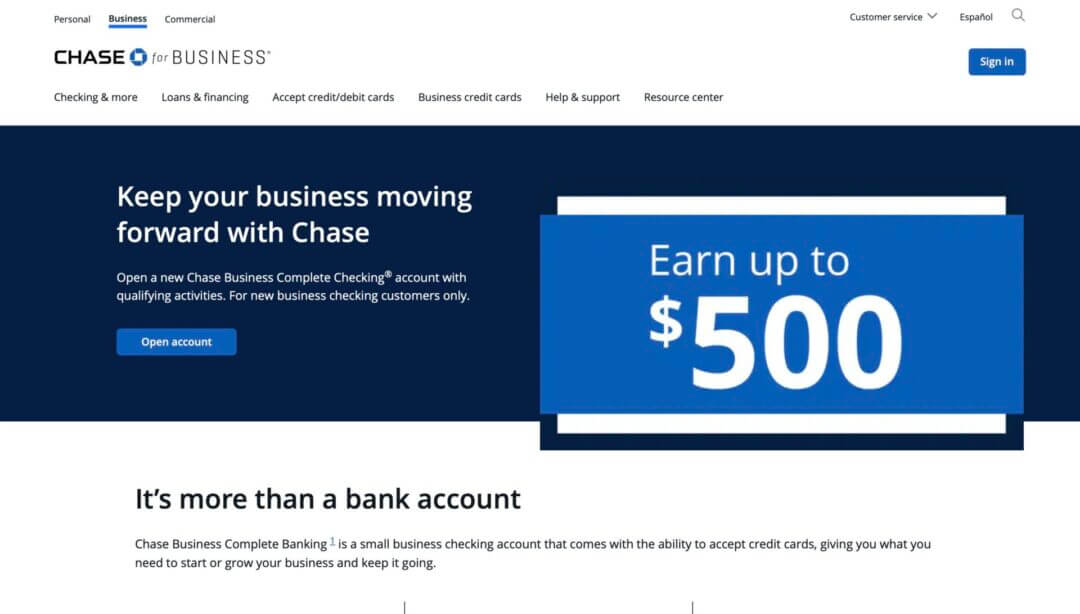
Who It’s Best For: Operators who want a large-bank setup with branches, predictable ACH support, and a widely recognized institution (useful when other counterparties, suppliers, lenders, landlords, care about bank brand).
Pros
✔️ Strong fit for Amazon payouts because ACH infrastructure is mature and widely supported.
✔️ Physical branch access for cash handling and in-person support (useful for some retail-adjacent brands).
✔️ Monthly service fee can be waived if you meet specific requirements (e.g., minimum balance rules).
Cons
❌ Standard fee structure and “big bank” pricing model can add up depending on transaction patterns (especially if you move money frequently via wires rather than ACH).
❌ Product experience is designed for broad SMB use, not e-commerce-specific workflows.
Ideal Seller Profile: U.S.-based Amazon brand with stable revenue, preference for a traditional relationship bank, and the discipline to meet fee-waiver thresholds
Bank Of America Business Advantage Fundamentals Banking

Who It’s Best For: Sellers who want a major U.S. bank with strong consumer-to-business payment rails (e.g., Zelle for Business), and straightforward integration into common bookkeeping workflows.
Pros
✔️ Clearly defined monthly fee structure with waiver options; BofA also advertises an initial “no monthly fee for 12 months” period for this product.
✔️ Offers Zelle® for Business and highlights QuickBooks® integration as part of the Business Advantage ecosystem.
Cons
❌ Like most traditional banks, you should expect more lengthy onboarding and documentation.
Ideal Seller Profile: U.S.-based Amazon sellers who want a recognized bank brand, need mainstream payment rails, and prefer a conventional bank account that integrates cleanly into accounting systems.
Fintech Business Banks
Mercury
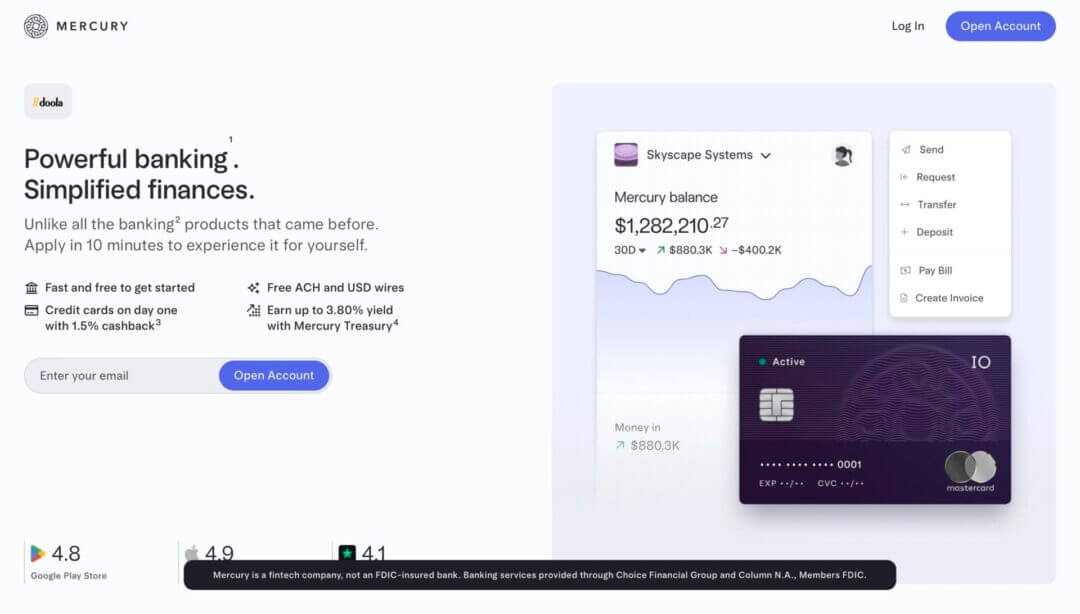
Who It’s Best For: E-commerce operators who are online-first and want a streamlined experience for ACH-based money movement, clean separation of funds, and modern controls.
Pros
✔️ Mercury positions its core business banking as free to use (no account minimums), and notes it’s free for customers to pay you by ACH transfer, wire, or check through Mercury.
✔️ Strong orientation toward workflows that matter for Amazon sellers: fast, trackable transfers and operational clarity.
✔️ The bank has highlighted same-day ACH capabilities for eligible transfers (helpful when managing suppliers or time-sensitive operating needs).
Cons
❌ Best fit when your business is comfortable operating without branches/cash deposits.
❌ Not every business profile or edge-case entity structure will be a smooth fit. Plus, fintech underwriting can be selective.
Ideal Seller Profile: Digitally native Amazon sellers who want speed, low-friction payouts, and clean treasury operations, particularly brands reinvesting frequently into inventory and ads.
Brex Business Account

Who It’s Best For: Scaling brands that want consolidated cash management and business spend controls, and prefer a platform like Brex.
Pros
✔️ Brex states it does not charge transaction fees when sending domestic wires, international wires, ACHs, or checks via the Brex business account (while noting third-party banks may still charge fees).
✔️ Brex publishes a fee schedule showing $0 fees for ACH and for incoming/outgoing domestic and international wires on its side (again, intermediary/recipient fees may apply).
✔️ Suitable for organizations that want structured control around money movement and spend.
Cons
❌ As with most fintech providers, onboarding requirements can be strict depending on risk signals.
Ideal Seller Profile: A growth-stage Amazon business with finance discipline, recurring payouts, and a need for scalable controls, especially if you also want a unified spend and cash platform.
Online-Only Business Accounts
Bluevine Business Checking
Who It’s Best For: Amazon sellers who want a lean, online checking account optimized for ACH and frequent cash movement, without traditional bank overhead.
Pros
✔️ Bluevine emphasizes no monthly fees and free standard ACH transfers (plan-dependent details exist for same-day ACH and wires).
✔️ Clear published pricing for domestic wires and same-day ACH (useful if your ops require faster settlement): same-day ACH and wire fees vary by plan.
✔️ Designed for online-first operations, which aligns well with Amazon sellers who rarely need branch services.
Cons
❌ Wire pricing exists (even if standard ACH is free), so sellers who rely heavily on wires for suppliers should model costs carefully.
❌ Like any online-only option, it may not be ideal if you need cash deposits or branch-based services.
Ideal Seller Profile: Amazon sellers with a primarily digital cash cycle, Amazon payouts in, suppliers/3PL out, who want simple fees and dependable ACH rails.
Relay
Who It’s Best For: Operators who want to separate cash flows cleanly (e.g., inventory, ads, taxes, owner pay) using multiple checking accounts, without paying traditional banking fees.
Pros
✔️ Relay has a $0/month starter tier and positions its core offering as no hidden fees/minimum balances.
✔️ Operationally useful feature for e-commerce: the ability to create multiple checking accounts to segment cash (helpful for disciplined Amazon cash-flow management).
✔️ Relay has also published plan updates and tiers (useful if you expect to upgrade for advanced workflows).
Cons
❌ Feature depth varies by plan; if you need more advanced payment speed or controls, you may need a higher tier (and should model that cost into unit economics).
❌ As with other online-first providers, it is not built for cash-heavy businesses.
Ideal Seller Profile: Amazon operators who want strong internal cash organization (multiple buckets.
Best Bank Accounts for International Amazon Sellers
Here are the best bank accounts often chosen by non-U.S. Amazon sellers receive and manage payouts, hold multiple currencies, and optimize foreign exchange costs.
These accounts are not U.S. retail bank accounts but are frequently used as an international Amazon seller bank account due to their multi-currency, USD receiving, and e-commerce-friendly capabilities.
Wise Business
Who It’s Best For: International sellers who want transparent fees, true mid-market FX rates, and multi-currency receiving without the overhead of a traditional bank.
Pros
✔️ Supports receiving and holding funds in 40+ currencies including USD, EUR, GBP, and more.
✔️ Account details available in major currencies so you can receive local payments (e.g., USD routing numbers).
✔️ Transparent, often lower FX costs because Wise uses the mid-market exchange rate with clear fees.
✔️ Integrates well with global business operations and accounting systems.
Cons
❌ Not FDIC-insured as a bank, since Wise is a licensed financial institution (funds are safeguarded rather than insured).
❌ May need supplemental local banking or payout routes for certain supplier payments or tax requirements.
Ideal Seller Profile: Non-U.S. Amazon sellers who:
- Sell in multiple marketplaces
- Require multi-currency holding and conversion flexibility
Payoneer Multi-Currency Business Account
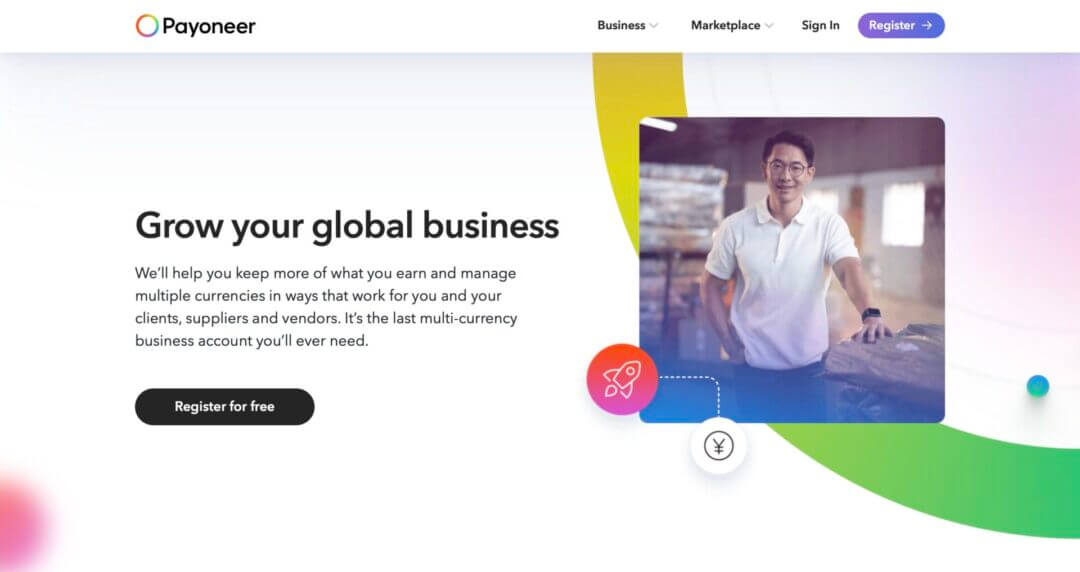
Who It’s Best For: Sellers who need local USD, EUR, and GBP receiving accounts and want a single dashboard for marketplace payouts across regions.
Pros
✔️ Provides local receiving account details in key currencies including USD, GBP, EUR, and others, making it easier to receive marketplace payouts.
✔️ Works in 190+ countries, with options to withdraw to your local bank or use funds directly.
✔️ Well accepted by e-commerce platforms and marketplaces for collections.
Cons
❌ USD receiving fees may apply (e.g., up to 1% depending on country and account setup).
❌ Exchange costs and intermediary bank fees can erode margin if used heavily for cross-currency transfers.
❌ Not a full and complete bank account. But more of a hybrid e-wallet/receiving solution.
Ideal Seller Profile: Non-U.S. sellers with:
- Regular payouts from Amazon in major currencies
- Need for local receiving details without a U.S. bank
- Moderate FX needs and preference for centralized payment consolidation
Airwallex Business Account
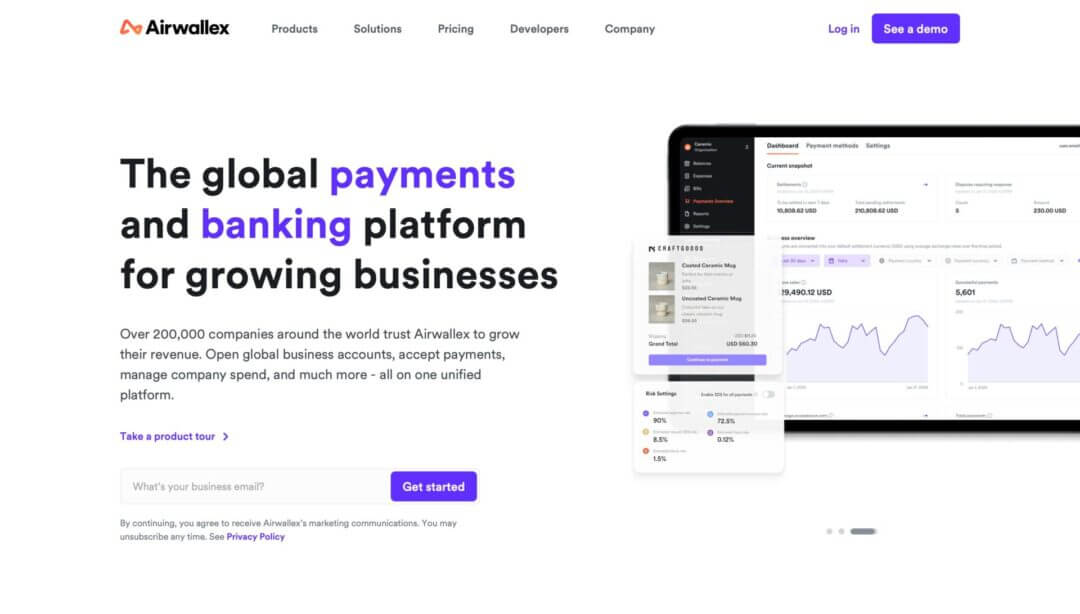
Who It’s Best For: Fast-growing international sellers who need comprehensive global account capabilities, low FX costs, and wide currency coverage with advanced treasury features.
Pros
✔️ Multi-currency accounts with local bank details across many regions (USD, EUR, GBP, AUD, etc.).
✔️ Designed for global e-commerce and international operations with efficient cross-border payments.
✔️ Typically lower FX fees and support for wallet-to-wallet transfers and local payment rails.
Cons
❌ May have account tiers with different fees (e.g., subscription based or higher volume based).
❌ Requires onboarding and documentation that may be more complex than simpler multi-currency wallets.
Ideal Seller Profile: International Amazon sellers who:
- Operate across multiple marketplaces with significant cross-border cash flow
- Require a treasury-grade account with local banking features in multiple currencies
Business vs Personal Bank Accounts: What Amazon Sellers Should Use
Amazon may allow personal bank accounts in limited cases, but for most sellers they become higher-risk as the business grows.
As discussed earlier, Amazon treats your bank account as part of your seller identity and compliance profile, not just a payout destination.
That becomes obvious during bank verification and re-verification cycles tied to identity, ownership, and compliance checks (including INFORM-related checks).
Why Personal Accounts Fail Reassessment More Often
Personal accounts can fail re-verification not because they are “invalid,” but because they are structurally weaker for Amazon’s checks, such as:
- Proof-of-Ownership Document Mismatch: Amazon may require a bank statement/certificate where the account number and details exactly match what’s entered in Seller Central; small mismatches trigger failures.
- Entity Structure Ambiguity: When Seller Central is set up as a business entity but payouts route to an individual’s personal account, it increases the likelihood of additional scrutiny and verification loops (because the audit trail is weaker).
- Marketplace/Country Payout Constraints: Amazon requires a bank account in a supported country for payouts. Plus, some “USD accounts” used by international sellers are not treated as eligible payout destinations in practice.
However, a business bank account reduces the risk of payout holds, disbursement delays, and repeated verification failures caused by identity/ownership mismatches, as the account holder name and documents align better with the Seller Central legal entity and Amazon’s verification requirements.
It also improves operational governance. For example:
✔️ Reconciliation is simpler because Amazon payouts, refunds, fees, chargebacks, and reimbursements are separated from personal spending (cleaner books and faster month-end close).
✔️ Tax reporting is cleaner because business income/expenses are traceable to the business entity rather than mixed with personal transactions.
✔️ Access control is easier because you can add users/roles as the team grows (finance, ops, agency partners) without sharing personal banking access.
doola’s POV:
If you are testing Amazon at low volume, a personal account can be a short-term bridge.
But if you run ads, depend on predictable cash flow for inventory, sell across marketplaces, or operate through an LLC/company, a business account should be treated as a risk-control decision, not an “upgrade.”
How Banking, Taxes, and Compliance Are Connected for Amazon Sellers
For Amazon sellers, banking, taxes, and compliance are not separate systems. They are tightly linked, and Amazon’s internal controls are designed to cross-check all three continuously.
This is the core of Amazon seller compliance approach in 2026.
Why Banks Care About Entity Structure
Banks are obligated to verify beneficial ownership and understand the nature of business activity. That obligation is higher for accounts receiving marketplace payouts, because the bank is effectively servicing a business with frequent third-party payments.
And, banks classify your account based on:
- Who owns it: individual vs LLC/corporation
- How it is taxed: personal tax ID vs EIN-linked entity
- How it behaves: consistent business inflows/outflows vs mixed personal spending
- Where activity originates: domestic vs cross-border flows and counterparties
As your Amazon volume grows, banks reassess these factors more frequently. That is why an account that “worked fine for months” can still be challenged later.
Seller Central verification typically relies on consistency across three records:
- Seller Central legal entity (the name and type of business you selected)
- Tax identity (EIN for a U.S. entity, or the relevant tax identifier for your structure)
- Bank account ownership (account holder name + statement evidence)
Amazon’s payout system is designed to prevent a common risk pattern: a seller account representing one entity, while funds are routed to a different person/entity.
So, it checks for alignment.
In operational terms, this means:
- If Seller Central is under “ABC Trading LLC”, the payout account should also be under “ABC Trading LLC” (not a founder’s personal name, not a shortened trade name).
- If your tax profile is EIN-based, Amazon expects the banking profile to reflect that same business identity, not an unrelated personal account.
Where Taxes Enter the Picture
mazon and banks both rely on clean traceability because tax reporting depends on it:
- Income tax reporting: Business income should map to the correct entity and tax ID.
- Sales tax / VAT details: The jurisdiction where your business operates often dictates its marketplace activity. Therefore, all documentation must accurately reflect how the business is legally represented in that jurisdiction.
- Auditability: If records show business revenue but payouts go to an account held by an individual, or to an account in a country different from the one listed on the seller profile, the financial audit trail becomes less clear and harder to verify.
| Why Mismatches Cause Payout Holds And “Freezes”
A payout hold typically happens when Amazon cannot confidently reconcile the three inputs (entity, tax identity, bank ownership). The most common mismatch patterns look like this: ⚠️ Entity mismatch: Seller Central = LLC name, bank account = founder’s personal name ⚠️ Tax mismatch: Seller profile uses EIN/business identity, but banking documents support only personal ownership ⚠️ Name formatting mismatch: legal suffix missing (“LLC/Inc/Ltd”), abbreviations, punctuation differences, or trade name vs legal name ⚠️ Country/rail mismatch: seller operates cross-border but uses an account structure that does not reliably meet Amazon’s payout rail requirements (especially when U.S. ACH capability is expected) ⚠️ Documentation mismatch: bank statement does not display the same legal name/account details entered in Seller Central (or shows a different holder) ⚠️ Mixed-use behavior: heavy personal transactions in the same account receiving marketplace payouts, increasing bank scrutiny and compliance flags When a mismatch is detected, Amazon’s safest control is to pause disbursements until the deposit method is re-verified. It is not a “penalty”; it is a risk-control mechanism. |
Why Forming A US Company Simplifies Amazon Banking
For international sellers selling into the U.S., forming a U.S. company (typically an LLC) simplifies the Amazon banking process. This is because a U.S. company creates a single, consistent identity, offering:
- One Legal Entity Name: Used consistently in Seller Central and on the bank account.
- One EIN: A consistent tax identity tied to the entity.
- A US-Domiciled Bank Account: This aligns with U.S. payout expectations and verification procedures.
- Cleaner Documentation: Entity formation documents, EIN confirmation, and bank statements will all match.
In short, the core benefit is predictability, leading to fewer ambiguous situations, fewer re-verification cycles, and a stronger audit trail as your sales volume grows.
How doola Helps Amazon Sellers Set Up The Right Bank Account

Most payout and verification problems come from one thing:
The business identity in Seller Central, the tax profile, and the bank account ownership don’t match tightly enough.
When Amazon or the bank re-checks your setup, those gaps show up as delays, document requests, or payout holds.
doola helps Amazon sellers set up the basics in a way that holds up as volume and scrutiny increase:
- U.S. LLC formation: Establishes a clear legal entity instead of relying on a personal or loosely defined setup that becomes fragile as payouts increase.
- EIN setup: Ensures the tax identity matches the business entity Amazon and banks expect to see.
- Banking-ready structure: Allows the payout account to be opened under the exact legal name used in Seller Central, reducing ownership and naming conflicts.
- Ongoing compliance support: Keeps the setup consistent as volume grows, marketplaces are added, or re-verification occurs.
For non-U.S. sellers, this matters more. Cross-border accounts tend to face more reviews, and resolution timelines are often slower. Getting the entity–tax–bank setup right upfront reduces interruptions later when cash flow is on the line.
Sign up for a quick chat with our formation experts to know more.
FAQs

Do Amazon sellers need a business bank account in 2026?
Amazon does not mandate a business bank account in every case, but for most active sellers it is effectively required.
Once payouts increase, ads are running, or re-verification is triggered, personal accounts become more likely to cause delays or holds.
A business account aligns better with Amazon’s verification and compliance checks.
Can I use a virtual or fintech bank account for Amazon payouts?
Yes, provided the account supports Amazon’s payout method (ACH for U.S. marketplaces) and is opened under the same legal name as your Seller Central entity.
Many fintech accounts work well, but issues arise when the account structure, routing, or ownership details are unclear.
What is the best bank account for international Amazon sellers?
There is no single “best” option. Early-stage sellers often use multi-currency accounts to receive USD, EUR, or GBP.
As volume grows, many international sellers move to a U.S.-domiciled bank account to reduce verification risk and improve payout stability.
Does Amazon accept personal bank accounts?
In limited cases, yes. However, personal accounts are more likely to fail re-verification as the business scales or compliance checks increase. They should be viewed as temporary, not long-term infrastructure.
How do currency conversion fees impact Amazon profits?
FX fees compound quickly. Even small spreads can materially reduce margins over time, especially for high-volume or multi-marketplace sellers.
Controlling when and how conversion happens is important for profitability.
What happens if my bank account doesn’t match my Amazon entity?
Amazon may request additional documents, reject the deposit method, or place payouts on hold until the mismatch is resolved.
Name, ownership, or country inconsistencies are common triggers.
Should I open a US LLC to get better banking for Amazon?
For sellers focused on the U.S. marketplace, especially non-U.S. sellers, a U.S. LLC often simplifies banking, verification, and payouts.
It reduces ambiguity across entity, tax identity, and bank ownership, which lowers the risk of disruption as the business grows.
News
Berita Teknologi
Berita Olahraga
Sports news
sports
Motivation
football prediction
technology
Berita Technologi
Berita Terkini
Tempat Wisata
News Flash
Football
Gaming
Game News
Gamers
Jasa Artikel
Jasa Backlink
Agen234
Agen234
Agen234
Resep
Download Film
A gaming center is a dedicated space where people come together to play video games, whether on PCs, consoles, or arcade machines. These centers can offer a range of services, from casual gaming sessions to competitive tournaments.
Comments are closed, but trackbacks and pingbacks are open.